Risk assessment is one of the most fundamental tools used in health and safety management. Regardless of industry, project size, or job role, it remains the primary method for identifying hazards, evaluating risks, and determining appropriate control measures. When carried out correctly, a risk assessment helps prevent injuries, occupational illnesses, property damage, and operational disruptions.
At its core, a risk assessment seeks to answer three essential questions:
- What hazards are present in the activity?
- How severe could the consequences be if something goes wrong?
- What measures can be implemented to eliminate or reduce the risk to an acceptable level?
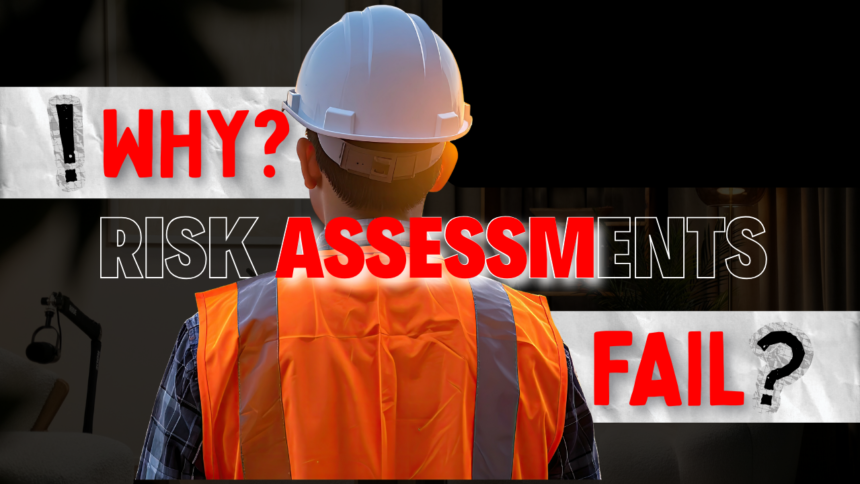
Despite its importance, risk assessment often becomes a routine paperwork exercise rather than a meaningful safety tool. When this happens, critical risks may be missed, control measures may be ineffective, and the likelihood of incidents increases. This article explores five common ways in which risk assessments fail and explains how these failures can be avoided.
Writing a Risk Assessment Without Fully Understanding the Activity
One of the most frequent and serious errors in risk assessment is developing the document without a clear and complete understanding of the activity being assessed. A risk assessment is only as good as the assessor’s knowledge of the work involved.
When activities are poorly defined, risk assessments are often based on assumptions rather than actual work practices. For instance, categorising a task simply as “electrical work” does not provide sufficient detail. Electrical work may include cable pulling, live testing, panel installation, termination, or commissioning. Each of these activities involves different hazards, levels of risk, and required control measures.
If the assessor does not understand the specific task, hazards tend to be identified in a generic manner, and control measures become broad and ineffective. As a result, the assessment may appear complete but fail to address real site conditions. Workers may then be exposed to unrecognised risks, increasing the potential for accidents.
To avoid this issue, risk assessments should only be prepared after the activity has been clearly defined. This requires observing the task, understanding the sequence of work, identifying interfaces with other activities, and consulting with those who perform the work. A well-defined activity forms the foundation of an effective risk assessment.
Using Templates Without Proper Review and Adaptation
Risk assessment templates are widely used and can be useful tools when applied correctly. However, problems arise when templates are copied and reused without being reviewed and adapted to suit the specific project, location, or activity.
A common example is the repeated use of the same working-at-height risk assessment across multiple sites. These documents often include standard control measures such as “install guardrails at all open edges.” While this may be appropriate in some situations, it may be impractical or impossible in others due to structural limitations, temporary work conditions, or design constraints.
When control measures cannot be realistically implemented, they remain theoretical and are often ignored by workers. This creates a false sense of security, where risks appear to be controlled on paper but remain unmanaged in practice.
Effective risk assessments require critical thinking. Templates should be treated as guidance rather than final solutions. Each identified hazard must be reviewed in the context of the actual site conditions, and alternative control measures should be considered where standard controls are not feasible. This ensures that the assessment remains practical and relevant.
Failing to Consider Human Factors and Behaviour
Another significant weakness in many risk assessments is the failure to adequately consider human factors. While hazards are often identified in relation to equipment, materials, or environments, the influence of human behaviour is frequently underestimated.
In reality, many incidents occur not because control measures are absent, but because they are bypassed. Workers may take shortcuts due to time pressure, fatigue, familiarity with the task, or overconfidence. For example, a lockout–tagout procedure may exist, but a worker may choose to skip it for a task perceived as quick or low-risk.
Risk assessments that focus only on physical hazards fail to address these behavioural risks. A robust assessment should consider how people are likely to behave under real working conditions. This includes factors such as workload, supervision, competence, fatigue, and organisational pressure.
Control measures should therefore extend beyond physical safeguards and include training, supervision, clear communication, adequate rest periods, and behavioural safety interventions. By recognising human factors as potential hazards, risk assessments become more realistic and effective.
Not Involving the Right People in the Risk Assessment Process
Risk assessments are often developed by a single individual, usually at a desk, without sufficient input from those who are directly involved in the work. While this approach may be efficient, it significantly reduces the accuracy and effectiveness of the assessment.
Workers, supervisors, and engineers who perform or oversee the task have practical knowledge that cannot be gained from assumptions, drawings or procedures alone. They are aware of informal work practices, site-specific challenges, and potential shortcuts that may not be documented elsewhere.
When these individuals are involved in the risk assessment process, hazards are more accurately identified and control measures are more practical. In addition, involving workers strengthens a sense of ownership. When people contribute to identifying risks and developing controls, they are more likely to follow them.
Conversely, excluding the right people often results in risk assessments that contain blind spots and unrealistic controls. Such documents may meet compliance requirements but fail to improve safety performance.
Selecting Control Measures Before Clearly Identifying Hazards
A common procedural mistake in risk assessment is the tendency to list control measures before thoroughly identifying and analysing hazards. This approach undermines the logical structure of the risk assessment process.
Control measures are only effective when they are directly linked to specific hazards. When hazards are not clearly defined, controls tend to default to generic solutions such as personal protective equipment, warning signs, or barriers. While these may provide some level of protection, they often do not address the root cause of the risk.
For example, failing to consider the location of the activity, nearby operations, environmental conditions, or simultaneous tasks can result in controls that do not reduce risk effectively. This again leads to a situation where risks appear to be managed on paper but persist in reality.
A systematic approach should always be followed: hazards must be identified first, risks assessed in terms of likelihood and severity, and control measures selected based on the hierarchy of controls. This ensures that controls are meaningful, targeted, and capable of reducing risk to an acceptable level.
Conclusion: Making Risk Assessments Meaningful
Risk assessments are not merely documents required for compliance; they are practical tools intended to protect people. Their effectiveness depends on the quality of thought, consultation, and analysis invested in their development.
Health and safety professionals should regularly review their risk assessments and reflect on the following questions:
- Is the activity clearly defined and understood?
- Are the hazards specific and realistic?
- Have human factors been considered?
- Were the right people involved in the process?
- Are the control measures practical and actually implemented on site?
If the answer to any of these questions is negative, the risk assessment requires improvement. Addressing these weaknesses proactively can prevent incidents, improve safety culture, and ensure that risk assessments fulfil their intended purpose.